EQUIPMENT TRAIT
A blue-green stone carrying what matters onward across distant lands and ages
December’s birthstones include turquoise, tanzanite and zircon.
This site features turquoise to match the birthstone used in the daily birthday readings.
For thousands of years, people in many places have layered wishes and stories onto this stone whose colors range from blue to green.
What did they wish for? Let’s follow the old records one at a time.
ARCHIVE OF THE TURQUOISE
Turquoise’s strengths,
through the old records
One fascinating thing about turquoise is that it has been cherished far beyond a single country.
Ancient Egypt, ancient Persia, China, what is now Mexico, the American Southwest and Europe: distant places developed different uses and stories for the same gem.

The same blue-green stone was cherished again and again in places so far apart.

Yes. Looking at the wishes left in each place lets us glimpse the long journey turquoise itself has taken.
ANCIENT RECORD Ⅰ
A blue-green color cherished for more than five thousand years
Turquoise was used in adornments in ancient Egypt more than five thousand years ago.
The ancient Egyptian word for the stone is also associated with joy and delight.
Across more than five thousand years, the same blue-green stone is still here before us. It feels like an unexpected connection, as though that distant word for joy has traveled with it.
- Joy
We read this as a strength for noticing small moments that move or delight you and carrying that feeling into your next step.
Did people five thousand years ago look at this color and think it was beautiful too?
It is wonderful to imagine. Even as the ages change, moments of joy may connect us somewhere along the way.
ANCIENT RECORD Ⅱ
Ancient turquoise and the wish to move forward
Turquoise ornaments have been found at archaeological sites in what is now Iran dating to around 7000 BCE.
In Persia, the name of turquoise came to carry meanings associated with victory and success.
Those words can be read alongside the hopeful wishes people entrusted to the stone: may things move in a good direction.
- Progress
We read this as a strength for remembering where you want to go and choosing a step you can take next.
Victory feels more familiar when I carry it as a wish to move in a good direction.
Yes. Each glimpse of the blue-green stone can remind you where you want to turn your feet. That is a lovely way to make it a personal charm for progress.
ANCIENT RECORD Ⅲ
A stone given with a wish to be remembered
European tradition tells of giving a turquoise ring with a wish that the recipient will not forget the giver.
Affection is entrusted to a small stone that can be worn, as well as expressed in words.
The story makes it a sign for remembering someone dear and the memories you share, even during time apart.
- Connection
We read this as a strength for carefully carrying the promises and memories of an important relationship within you.
Perhaps they looked at the stone and remembered someone they could not see.
Some people probably did. Connection is more than staying beside someone all the time. Remembering what mattered, even when you are apart, is one way to keep a bond.
ANCIENT RECORD Ⅳ
A wish for safety through journeys and everyday life
Turquoise has a long tradition as a stone of protection.
It has been cherished in places including Tibet and the American Southwest in jewelry, protective objects and ceremonial items.
Wishes for a traveler or someone dear to stay safe have added stories of protection to turquoise.
- Protection
We read it as a protective symbol of treating yourself and the people you cherish with care and wishing for their safety.
They entrusted a wish for someone to be safe to a little blue-green stone.
Yes. Caring for someone dear is a feeling we can understand across the ages. Turquoise offers a lovely way to bring that wish into everyday life.
ANCIENT RECORD Ⅴ
A stone that crossed the world and endured in changing forms
Turquoise has left its mark in many cultures: ancient Egyptian jewelry, Chinese carvings, mosaics made in what is now Mexico and jewelry from the American Southwest.
The British Museum preserves mosaics hundreds of years old, made by arranging small pieces of blue-green turquoise.
The stone has stayed close to people beyond a single era’s fashion, receiving new uses and meanings as it passed into different lands.
- Legacy
We read this as a strength for giving what you have received a form that fits your life now, then passing it to the next person or generation.
Even with the same turquoise, the form and use change from place to place.
Yes. Receive something precious, give it a form that suits the time and pass it onward. The history of turquoise itself feels like that kind of journey of inheritance.
WHY TURQUOISE IN DECEMBER?
Why does turquoise
suit December birthdays?
December is the final month of the year.
As an even-numbered month, this site reads it through a rhythm of receiving, connecting and arranging.
December’s two zodiac signs also offer echoes of turquoise’s long journey.
Move outward.
Receive something there.
Choose what matters and give it a form that can last.
Then pass it onward.
Across distant lands and ages, turquoise has received stories of joy, wishes for progress, connection and protection.
Placed alongside a December birthday, this blue-green stone can become a symbol for nurturing what you receive from the world, arranging it into your own path and carrying it to the next person or season.
That is a fitting way to imagine equipping it.
Sagittarius
In conventional Western astrology, Sagittarius widens its horizons and moves forward by exploring new knowledge and experiences firsthand.
Explore Sagittarius →♑December 22–31Capricorn
Capricorn gives discovered goals and values a practical form and builds toward them over time.
Explore Capricorn →December ends the year, but turquoise makes it feel especially like passing something onward.
The year’s end is also a time to choose what you want to carry into the next one. Thinking of turquoise’s long journey, that image of a bridge suits December beautifully.
TURQUOISE PROFILE
What kind of gem
is turquoise?
- December birthstones
- Turquoise, tanzanite and zircon
- Featured stone
- Turquoise
- Japanese name
- Toruko-ishi (Turkish stone)
- Color featured here
- Blue-green
- Mineral
- Turquoise is a mineral in its own right
- Mohs hardness
- 5–6
- Colors
- Sky blue through blue-green to green
- Patterns
- Some stones retain a web of surrounding rock, called matrix
- Name origin
- A French term meaning Turkish stone
After exploring the stories, let’s look at the gem itself.
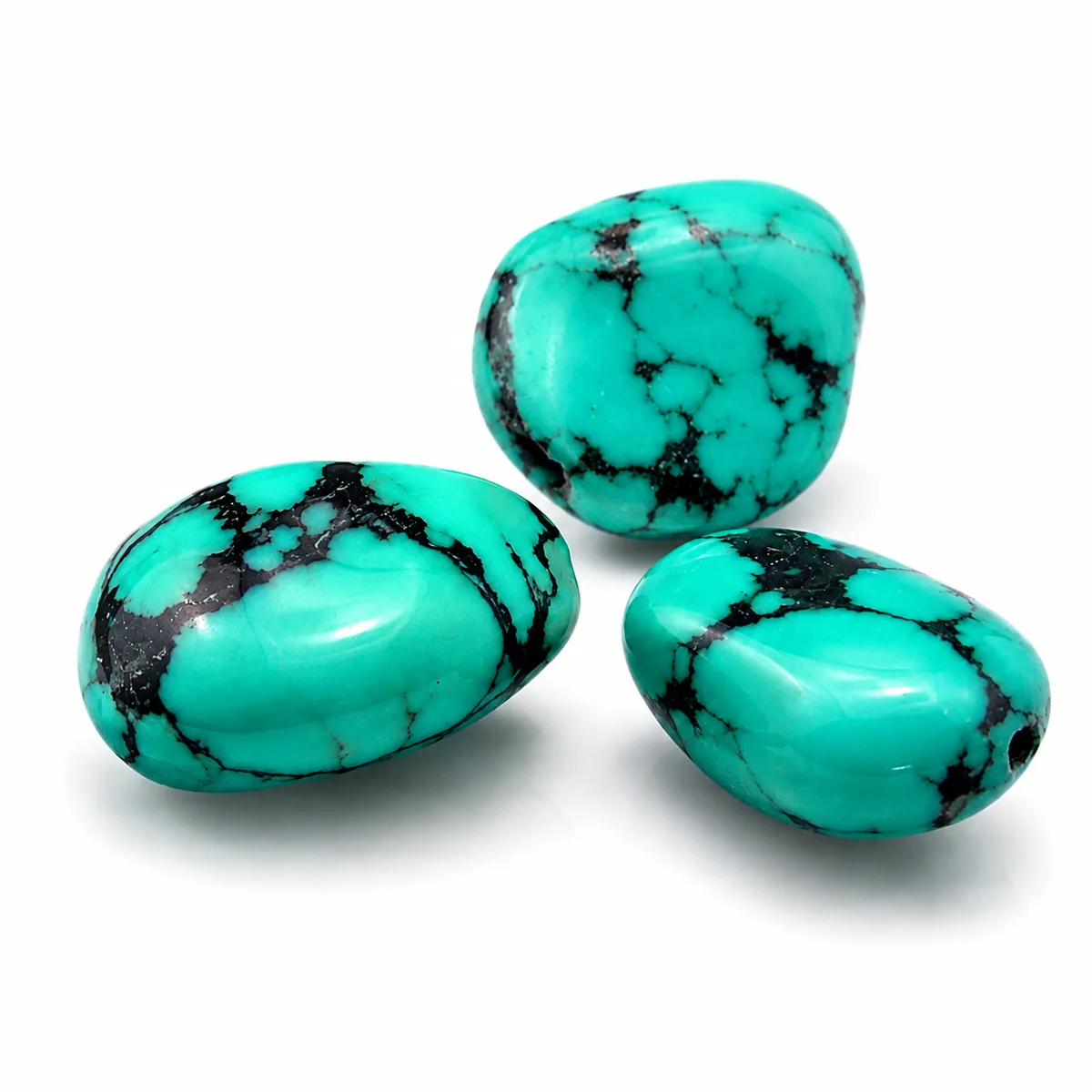
Turquoise ranges from bright, sky-like blue to blue-green shades with a hint of green.
Some stones retain brown or dark web-like patterns, another characteristic expression of turquoise.
This page features blue-green, between blue and green, to match December’s daily readings and lucky color.
Turquoise is a relatively soft gem with a wide range of blue and green appearances. Even its matrix patterns offer a way to enjoy the character of each individual stone.
TURQUOISE EQUIPPED
Carrying turquoise
into your December story
- Joy↑
- Progress↑
- Connection↑
- Protection↑
- Legacy↑
Ancient Egyptian stories of joy, Persian wishes for progress, gifts that remember someone far away, protective traditions and a history that has crossed the world.
The five equipment effects at the beginning translate those stories into words we can relate to today.
Each time I see turquoise, I could remember the strength I want now from its five stories.
Yes. The stone can remind you to ask what you want to receive with care today and what you want to pass onward. Using old stories as a cue for your own strengths is what equipping a stone means on this page.
You don’t have to believe.Just listen first.Which of turquoise’s symbolic strengths would you like to use today?